Saturday, October 3, 2015

MORNING WALKS AROUND THE VILLAGE OF MAKRAVANK

All summer, whenever I was home in Hrazdan, I would take an early morning walk around the village of Makravank, just behind Hrazdan where I live.  Other seasons I walk late afternoons. I will take you on a pictorial journey of this walk which is about two miles. It is mostly up hill to the monastery.  You can find the village of Makravank on Wikipedia if you want to read more about it and get the details. I don't know - I find it a very peaceful place - especially up at the monastery. Difficult to walk in the winter because of mud and the roads are not plowed of the snow.

 
Shooka just outside of my steps... All this
food is put out, and then taken in in the evening -
an incredible amount of work done solely by old women.
 
Old women who sell at the shooka.
They are both 75 years old. They dress like this
all summer. The one on the right was upset because
I took her picture. They dress very Russian. I love their
old and warn faces.
 
Rest shelter make of branches
and twigs just inside the village.
There is a bed/cot type thing in there
 and an old old table and chair.
 
Road leading into the village.  The pipe lines across the
road are gas lines. In Armenia they are all very old and
all are above ground except for in Yerevan, the capital city.
 
Barn in foreground and house after...Almost all
families have a cow or two, chickens, goat and maybe
a few sheep.
 
Here you can see the extreme poverty and harsh
living conditions.
 
All roofs are old metal, single pane old windows, no
insulation in the homes.
 
Typical village house.... Usually only one room
is heated in the winter and the family lives and sleeps
in this room with wood stove or gas heater - very old.
 
Most fences are made of bedsprings and/or bedsteads
i.e. old iron headboard/footboard as seen here.
 
Livestock are taken up to the field
every day by the old people. Sometimes
they stay with the animals or go back to
get them later in the day.
 
His beautiful old face...
 
Virtually every home in the village has a garden with
potatoes and beans. Notice the bean poles.. There are an
incredible amount of fruit trees with peaches, plums, apples,
pears and apricots.  The women can everything for winter and
potatoes are kept in the barn or root room above ground.
 
Livestock are also tied up everywhere and anywhere
with pieces of rope and somehow attached to the ground.
 
Hrazdan/Raykom as seen from up by the monastery.  I live
down on the left. Used to live in a high rise but now
on the third floor of a small building over a small
neighborhood grocery store.
 
Close to same view as above, only winter time.
 
 
Approaching the 11th century Makravank monastery.
 
View of the monastery...
 
Sculpted gravestones of priests from early centuries.
These are called khachkars and  there are thousands
of them all over Armenia.
 
Side door of monastery. It is locked. Families
in nearby houses keep the keys and if you can
find them home they will give you the key.  Inside the
tapestries are all tattered and torn and people often
light candles inside and little religious relics.
 
Another entrance. One time I saw blood in the snow
where a sacrifice of some animal was made.
 
Alter area inside of the monastery...
 
Another view of the alter area...
Notice the colors - paint.
 
Peace...I love this place.
There are hundreds of these monasteries
built almost the same, all over Armenia. The
architecture is the same with the round steeple design on
all of them.  They are always built in places of high
elevation - up on a hill or mountain. 


FULL LIFE CAMP - DANCING WITH DISABLED CHILDREN

My first summer in Armenia was filled by bringing American contra/barn dancing to the children of Armenia. I attended numerous summer camps, but by far the most moving for me was Full Life Camp in Stepanavan, northern Armenia. Here the children were all in some way disabled. They had Down's Syndrome, Cerebral Palsy, Spinal Bifida, club feet, profoundly deaf and other cognitive disabilities. There were young children and young adults.
The camp consisted of just a few buildings with bunk beds tightly arranged. There were handicapped access bathrooms and one big room that served as the dining hall and a place for other bigger events. Outside were picnic tables that served as places for the children's activities.
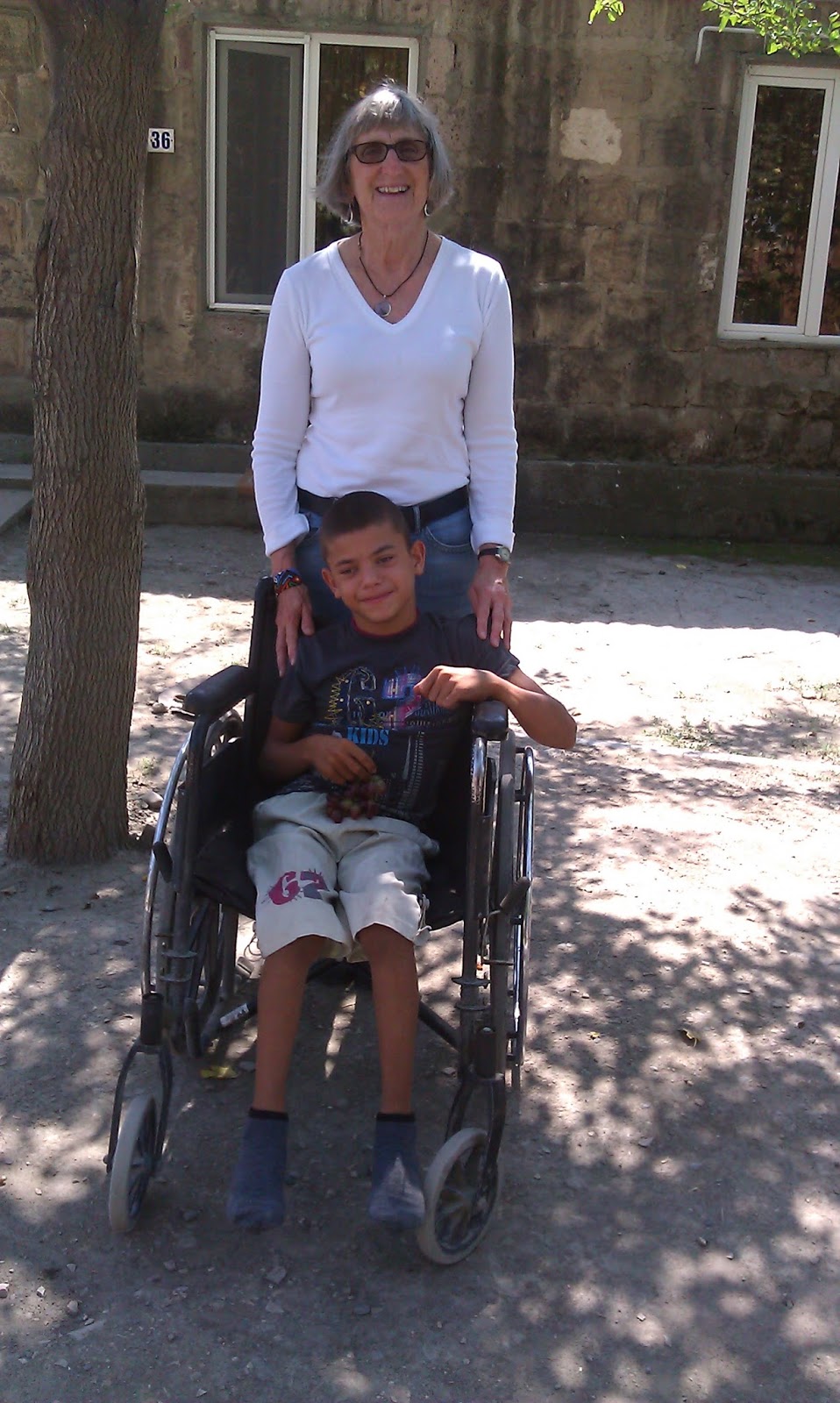
There were four weeks of camps, six days each. I went for two sessions. I taxied each day from Vonadzor, staying with my friend Satenik and her baby and husband. It was a one hour ride over the mountains. It was incredibly hot. I held three dance sessions each day with about 15 children in each group. The children loved the dancing. For many of them this was there first experience outside of their village. For many it was their first experience with other children in a group setting. Many of these children never leave their homes.  My little friend Gorg, from my PST village in Berkanush wash there  in his wheel chair with his mother and little brother.  Here, the children have a chance for a full life.
There was usually one Peace Corps volunteer there each week and other volunteers from all over Armenia, some dancers, musicians, artists, woodworkers and others who came to work with these children.

The first week we danced out under the
shade trees. It was really hot. The kids
took quickly to the dancing and loved it.
 
Dancing with Gorg in his wheelchair... He was so
happy to be with the other children and to be dancing :-)
 
Dancing La Bastringe . . I always taught this dance first.
 
And it's a 'swing' move :-)
 
La Bastringe with Gorg...
 
Singing outside with hand motions . . .
 
Brother and sister dancing. Many older
siblings would come to camp with their
disabled sibling to provide the care they
needed for the week. There were few counselors
for the children.
 
After the third session of the day I would play fiddle
tunes on the porch while the children waited for lunch.
After the first day they all wanted to hold and try out the
violin. I was happy to make this happen for them.
 
One on one with my fiddle....
 
The second week I was at camp they moved me
inside where it was so much cooler for dancing.
We had children in wheelchairs dancing too!!
 
If they were unable to dance, the children
were happy to add percussion to the recorded
music. I brought tambourines, spoons and shaker
eggs from America to Armenia with me.
 
I also brought my guitar to camp and we did singing
of American kid tunes i.e. Old MacDonald, If Your're
Happy and You Know It, etc etc. The children and young
adults quickly learned the tunes and loved them.
 
The favorite dance by far was Un, Deux, Trois, Poussait!!
Only in Armenian, Make, Yerkoo, Yerek and PUSH!!
We danced this to music of The Joys of Quebec. They
would ask to do this dance over and over again.
 
More of the Poussait dance!!
 
 Next summer I will return for all four sessions of Full Life Camp. Finally, I have found some real meaning in my time here in Armenia.
 
And lastly, this is me and Gorg in early
 fall back in his village. He now
smiles and talks non-stop. He is 12 years
old. Notice his chair has no foot pedals and his
legs, ankles and feet are permanently as they are
seen. He has never had physical therapy.


Friday, July 3, 2015

MY GREEK VACATION

So, I left Armenia for 10 days and went to Greece. It was lovely. I stayed 10 days in Athens and 7 days on Crete in the seaside down of .  I saw the Acropolis and other Greek ruins, ate wonderful food, did a botanical garden tour on a Segway (the most fun), and swam in the Mediterranean every day while on Crete.  I walked high up on a goat trail every morning in Panormos.

First restaurant where I ate Greek food - on the Platka..

Temple of Athena, or Aphrodite, cannot remember . . .

Nightlife on the Platka - area surrounding below the Acropolis..
There are outdoor restaurants/tavernas and shops with
everything to be found... The platka is open until  well after midnight..

The flea market as they call it . . .

On the Acropolis . . .famous goddess temple . . . 

The Parthenon on the Acropolis . . .

Parthenon - under renovation/construction

Amphitheater seen below the Acropolis

Acropolis Museum pieces . . . 

Walkway leading to apartment where I stayed in Athens
just below the Acropolis . . .

The original Olympic stadium . . .

Changing of the guard, Greek Army regulars in front of
the president's house  . . .

Me on my Segway . . . I loved this thing . . . It was the best . . .

View of the Acropolis from a nearby famous mountain where
I had dinner one evening . . . .

Car I liked and wouldn't mind having :-)

Favorite taverna for dinner in village of Panormos on Crete . . .

Panormos seaside village . . . Taken from cliffs on
morning goat walk . . .

View of the Mediterranean from goat walk cliffs . . . 

Favorite taverna sign . . .You had to go in and look in the
oven to decide what you would have for dinner.... opened at 6 p.m.

Kitty City station . . . cats everywhere and all well fed
at the stations and in the tavernas and restaurants. . .

Favorite cafe for morning cappuccino after goat cliff walk . . . 

Cats getting fed at the taverna . . . Everyone feeds the cats. . .

Got inadvertently caught up in a demonstration in front
of the president's house the last evening . . . 

View from my balcony in Panormos . . . .


Thursday, July 2, 2015

NATIONAL POETRY CONTEST

A number of years ago a Peace Corps Volunteer created and made sustainable an English spoken national poetry contest for Armenian school children.Now there is a very active Peace Corps volunteer committee to organize and make this happen on an annual basis March through May of each year.  It was my pleasure to enable some of my students to participate this year.

The contest begins at a PC volunteer or not a PC volunteer public school.  Students in grades 7-12 can participate. A list of selected poems from Robert Frost to Keats is generated each year with a different selection for 7th and 8th graders and for 9th through 12 graders.  The student his or herself selects their poem, memorizes it and practices with their English teacher or volunteer.   A school contest is held and the best chosen reciter from each grade in each school participating goes to the regional contest.  Then the best in each region goes to the national contest in Yerevan, Armenia's capital.

The students are judged on of course the words of the poem, correct pronunciation and the feeling given to the recitation.  From the 'feeling,' a judge can deduce if the student really understands the meaning of the poem.

I had two of my students, Narine and Nellie in the regional contest in Hrazdan this year. They were both in the 8th grade. Narine went on to be in the national contest in Yerevan.

Narine and Nellie, Hrazdan regional contest

Narine, Nellie and me at Hrazdan regional contest

The girls and me at the national contest in Yerevan. ..

Narine and me after the national contest. . .


The national contest was held at The American University in
Yerevan. This was the girls' first visit there and very exciting for them.

With this year's regional and national contests I introduced music into the contest atmosphere by providing musicians from my school along with me to play before the contests started and in some contests during the break while the judges were making decisions. The music was both Armenian and American.  I had two second grade boys playing the Armenian drums called 'dhole,'  Nellie and I played fiddle and guitar with Armenian and American folk tunes and Hannah (another PCV) and I played flute and fiddle together with Armenian and American folk tunes.  This as the first time this has occured - music at the poetry contests and it was a great cultural exchange opportunity for Armenians and Americans.


Second graders playing 'Dhole' Armenian drums. . .

Nellie and me on guitar and fiddle . . .

All of us together . . . .

Me and Hannah Frantz playing together in Yerevan.
Up until this time of PC service Hannah had been only a 
classical flutist.... She is now an experienced flute player of
 Armenian and American folk tunes !!!!  We also played together
at our swearing in ceremony last November. 


  1.